NBA All-Time Starting Lineups; top 15 Players @ each position (and the stats to prove it)
Stats don't lie. People lie. Stats can be presented in different ways. People will say Kobe has more career pts and more all star appearances than Jordan. That is STATISTICAL FACT. Kobe 33,521 (and counting) vs. Jordan = 32,292. Kobe 18 AS Games vs Jordan 14 AS Games. What those stats do NOT tell you is Kobe played 1342 gms (and counting) vs Jordan's 1072. That's 270 more games than Jordan. Meaning if Jordan played another 270 games he would need to average a whopping 4.5 ppg to match Kobe's career points. What it doesn't tell you is Kobe led the league in scoring 2x while Jordan led the league in scoring 10x. What it does not tell you is Kobe's career FG% is 44.7% while Jordan's is 49.9%. Longevity does not tell the entire story. Accumulation of statistics is a longevity play.
These numbers are put together to show greatness and rank greatness. This puts numbers and context around picking the NBA All-Time starting lineups (or in other words the top 15 players in each position).
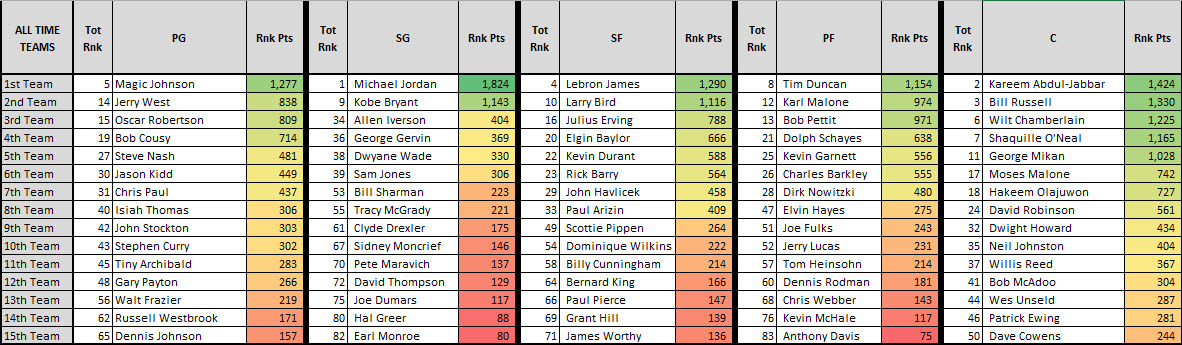
"ALL TIME TEAMS" = Ranks each player by position (1-15)
"Tot Rnk" = Players overall ranking based on criteria explained below
"PG/SG/SF/PF/C" = Positions
"Rnk Pts" = Based on criteria and points system described below, this is how the player measured on Greatness and why they are ranked where they are
"Rnk Pts / Gm" = This is informational only. This puts into context if the players greatness was driven by dominance or ongevity or both. Longevity is part of overall greatness so that's why "Rnk Pts" is used to rank the players.
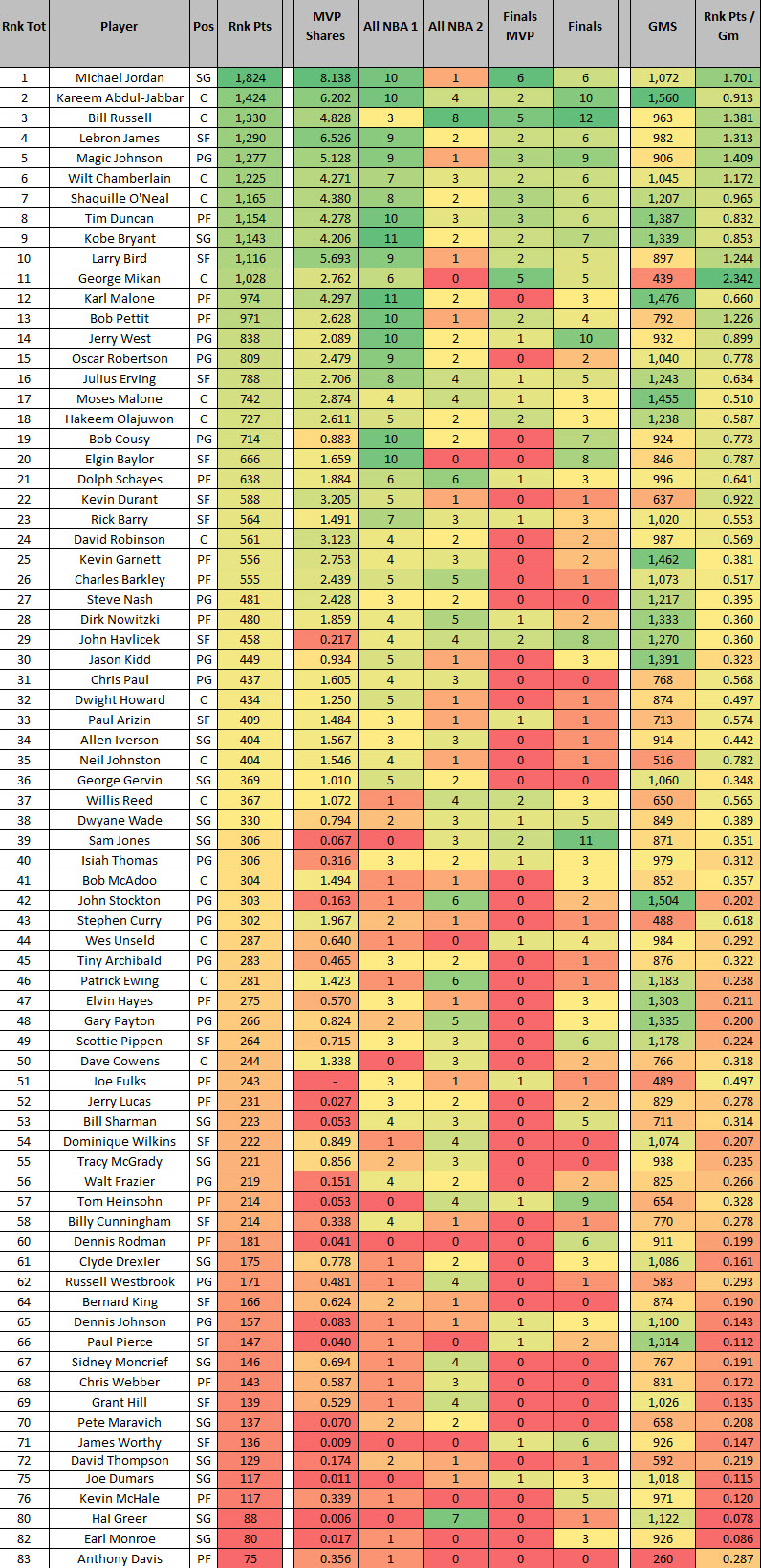
Below is the players rankings in total along with the criteria used to measure them (this ranks the same 75 players from above. The reason why "Rnk Tot" has numbers higher than 75 is because its 15 players at each position, while some positions may have more players ranked above the top 15 of another position.
Methodology:
Each category received a value. Each players individual accomplishments in each category were multiplied by the points value.
Used the following criteria (all stats are from basketball-reference.com)
MVP Award Shares (starting in 1954/1955 season): Why MVP shares vs just MVPs. Using MVP shares helps eliminate voter bias, voter fatigue, etc. Does anyone really think Karl Malone was the MVP over a Jordan and a 69 wins Bulls team? Voters do not always get it right, but MVP awards shares minimizes that impact by allotting value to those who didn't win. In years of a truly Unanimous MVP, the non-winners will receive minimal MVP shares, while in the Jordan/Malone example above, Malone received 0.857 MVP shares, while Jordan received 0.832 (More telling and truly reflective of value than Malone getting 1 and Jordan 0). For years before 1954, I used authors discretion in allotting MVP shares based on top 5 "Win Shares" and allocated the MVP shares based on average 1st place allotment, average 2nd place allotment, etc.
100 pts = MVP Shares. I believe this is the most telling figure to determine greatness relative to peers and time.
All NBA 1st and 2nd team (3rd team was only awarded starting in 1989/1990): Used All NBA as the baseline for performance vs pears. In this, by definition, already embedded are things like statistical dominance, defensive prowess (All Def teams only started in 1968/1969), etc, and more so apply those criteria on a relative bases. For example in 1961/1962, Wilt Chamberlain averaged 50.4 ppg and 25.7 rpg. Wow!!! Right?. That same year Oscar Robertson averaged a triple double 30.8 ppg, 12.5 rpg 11.4 apg, and Elgin Baylor averaged 38.3 ppg 18.6 rpg 4.6 apg. and Bill Russell won MVP. What do those stats mean? how do you compare it to today's NBA? How do you account for rule changes? All NBA encompasses all statistics and all value, to establish the best 1-2 players at each position for each year. If MVP = 100 pts, I figure All NBA 1st team is 33 pts (3 All NBA ~ = 1 MVP). and If All NBA 1st team is 33 pts, then All NBA 2nd team is 11 pts (3 All NBA 2nd Team = 1 NBA 1st Team). This again limits the punishment of playing in the Jordan era. or arguable the 2 best centers in the NBA beating each other out for 1st team All NBA over their careers.
33 pts = All NBA 1st team.
11 pts = All NBA 2nd team.
Finals MVP (starting in 1968/1969): Why is Finals MVP such an important criteria. = The best player on the best team, performing the best when it counts (except Jerry West who won the inaugural award in 1969 on the losing team). This is important because not all championship rings have the same historical value. Is Scottie Pippen's 6 rings more valuable than Larry Bird's 3? Scottie Pippen is an all time great, but he was Robin in all 6 of those championships, while Larry Bird was Batman for 2 of the 3. You can not ignore that of Kobe's 5 rings, 3 of them the finals were dominated by Shaquille O'neal. This allows you to give different levels of credit between Jordan's 6 rings and Pippen's 6 rings. When you start talking GOATs Finals MVP's outweigh just a championship ring. For the years before 1969, I used the following analysis to establish the Finals MVP before the award was given (http://www.basketballlists.com/2013/06/came-along-too-soon-7-players-who-would.html)
75 pts = Finals MVP. What's better than taking your team to the final and being the best player on that time.
Finals Appearances: Give credit where credit is due. Is it Malone/Stockton/Barkley/Drexler/Payton/Magic's fault they happen to dominate in the same era as the invincible Michael Jordan? This category acknowledges the achievement of making it to the finals, essentially being on the 2nd or 1st best team in the NBA. Elgin Baylor never won a ring (as he faced Bill Russell and the HOFers essentially his entires finals career), but Elgin deserves some credit for taking his team that far.
10 pts = Final Appearances takes away the "punishment" factor of playing against Jordan or Bill Russell.
Years in top 5 Leading League in Pts/Ast/Reb: John Stockton led the league in Assists 9x (the essence of being a PG), and many of those 9 seasons he out-assisted the Greatest Point Guard of all time Magic Johnson. Stockton didnt make an All NBA team until Magic's retirement, though he out performed Magic in a main category. This gives a little love to the league leaders. This does unintentionally minimize the impact of Small Forwards. PGs get assist, SG score pts, PF & C get reb and score pts. SF do a little bit of everything, and usually do not dominate in one particular area (Larry Legend for example)
15 pts = League Leader in Pts, Reb, or Ast.,
12 pts = 2nd place in Pts, Reb, or Ast
9 pts = 3rd place in Pts, Reb, or Ast
6 pts = 4th place in Pts, Reb, or Ast
3 pts = 5th place in Pts, Reb, or Ast
Adjustments to the stats. Judgement/Analysis was done to come up with MVP Shares before MVP award was in place in 1955, Finals MVP before 1969, ABA vs NBA adjustments to MVP share, All NBA awards, and Finals/Finals MVP
PROJECTED RANKINGS
There are 12 players on this list that are still active.
6 of them will likely finish their careers without gaining many additional Pts (Kobe, Wade, Pierce, Duncan, Garnett, Nowitzki), while 6 others will have a chance to increase their rankings significantly in their remaining years (CP3, Curry, Westbrook, Lebron, Durant, and Howard).
According to my estimation, Curry will move up ~27 spots to somewhere around 17th overall and 3rd on the All Time PG list. Chris Paul will move up ~2 spots on the All Time list but will remain at the 7th spot for PGs. Westbrook will jump up ~39 spots to 23rd over all and 6th All Time on the PG list. Lebron is already at 4th overall, and will move up to ~2nd overall. Durant will move up ~8 spots overall to 14th All Time, and to 3rd on the SF rankings. Dwight Howard will likely end his career where he stands...an impressive 9th on the All Time Centers list.