Syracuse Set to Shine in 2018-2019

Christmas came a little bit early for the Syracuse Orange this year. Their gift: a berth in the 2018 NCAA Tournament as the last team in the field. By all indications, the Orange were headed for the NIT, which would mark the third time in the past four years that Syracuse had failed to make the tournament. With 14 losses, a 10th place finish in the ACC, and a single Top 25 win, a chance to play for a championship looked bleak. But to everyone’s surprise, Jim Boeheim’s squad snuck into the field, and even they couldn’t believe it.
Syracuse’s performance in the tournament proved it belonged. Three straight wins over Arizona State, TCU, and a title contender in Michigan State put the previously overlooked Orange on the map. The run brought back shades of the 2016 team that narrowly made the tournament as a 10 seed, only to shock the college basketball world and win the Midwest region.
Lost in the frequent late-season madness is the fact that Syracuse hasn’t had a good season in five years. This is a university accustomed to making Final Fours, not First Fours. However, the dawn of the 2018-2019 season means that a fresh start is on the horizon, and this time, the Orange are in a position to shine.
What sets this Syracuse team apart from those of the past few years is continuity. The Orange return 91% of last year’s minutes this season, including its entire starting lineup. Tyus Battle, Frank Howard, and Oshae Brissett all return after finishing top five in the country in minutes played, with Battle and Howard ranking first and second per game.
This roster retention allows the Orange to pick right back up where they left off, playing some of the best defense in college basketball. Jim Boeheim has made his living in upstate New York off a signature 2-3 zone that proves year after year to be as stifling as any, but the perfectionist nature of his zone isn’t picked up so easily. It often takes all year to reach its peak. And with the personnel changing year in and year out, Syracuse only has a small window to play its best defense.
Early in the season, the Orange really struggled to rotate effectively. That was on display against Maryland.
Off an offensive rebound, Howard is too high up in the 2-3, allowing Justin Jackson to make an easy skip pass to Anthony Cowan, and from there everyone is scrambling to recover. Brissett closes hard, and they leave sharpshooter Kevin Huerter wide open in the corner for an easy triple. It’s a simple case of just being out of position, but it’s the kind of small failure that hindered Syracuse’s success on the defensive side of the ball early in the season.
As the season progressed, however, some of these kinks started to work themselves out. Syracuse exhibited textbook rotation against an extremely talented Duke team in late February.
After stopping the fast break, Syracuse sets up in their 2-3, denying the long ball. Duke’s game plan is picture perfect, and almost any defense in the country would have given up a dunk on this possession. Gary Trent Jr. feeds Wendell Carter a great entry pass, and Duke’s bigs make all the right passes in the post. It’s tremendous ball movement, but the Orange’s frontcourt trio rotates so well from one pass to the next that Duke can’t get a good shot off, and it culminates in a Bourama Sidibe block and a bucket in transition.
Syracuse’s defense was like night and day in these two games, and it showed at the end of the year. The Orange held their opponents to 56, 52, and 53 points, respectively, in their tournament wins.
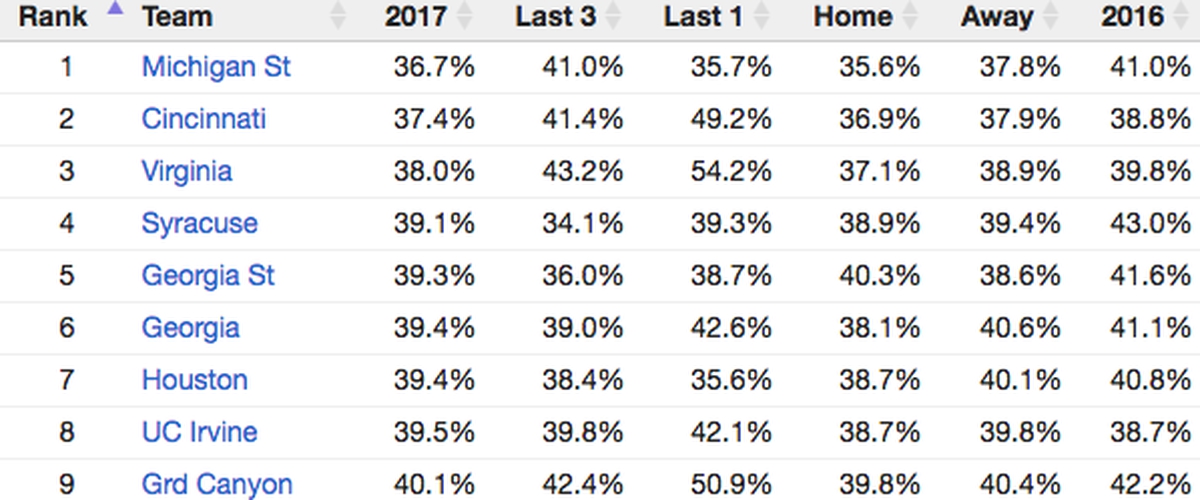
With virtually the entire roster returning, Syracuse has the personnel to make those numbers ubiquitous. The Orange already ranked 10th in scoring defense and 4th in opposing field goal percentage last season, and they only figure to improve.
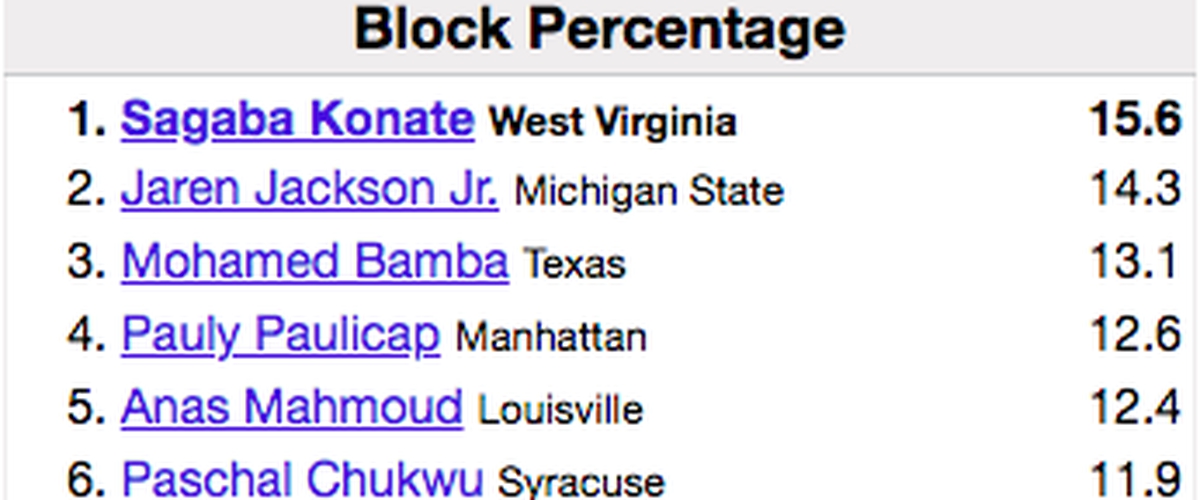
That stinginess all starts with Paschal Chukwu in the paint. The 7’2 center from Nigeria is as good a rim protector as Syracuse has had in years, and he hasn’t even scratched the surface of his potential. His 7’8 wingspan allowed him to finish in the top 20 in blocks, and sixth overall in block percentage, which represents the percentage of opponent two-point field goal attempts blocked while he was on the floor.
Between Chukwu and Brissett, who finished sixth nationally in defensive win shares, it’s not hard to see why Syracuse is a force to be reckoned with down low, but that’s not even the most impressive part of this zone.
The primary way to beat a 2-3 zone is by simply outshooting it, swinging the ball around the perimeter and finding shooting pockets on the wings, but Syracuse’s zone denies even those opportunities, and recruiting is a large reason why. Boeheim expertly recruits for his zone, targeting tall and long guards to anchor his zone and contest shots. Howard (6’5) and Battle (6’6) cover more ground than most guards defensively, and severely limit high-percentage looks from beyond the arc. Despite playing a zone, Syracuse still held opponents to a 31.8% clip from three, 17th in the nation in that regard. That’s 2.5% and 119 spots higher than a year ago.
Watch them seamlessly rotate and cover ground to force a tough three point shot from Grayson Allen.
Syracuse’s ability to stymie opponents inside and out puts the Orange in a league of their own, and only late in the season did they reach their peak. Now with the additions of top recruit Jalen Carey and ECU-transfer Elijah Hughes, they won’t have to rely on ungodly minute totals to keep them in games. For the first time in years, Syracuse has the continuity in the locker room to have success from day one.
Don’t expect this team to sneak in the door to get in the tournament come March. Expect them to break the door down.